

What the evidence actually says
Coaching used to be sold on conviction. It no longer has to be – provided we are honest about what the research does and does not establish.
It works, reliably, and by a respectable margin
It works, reliably, and by a respectable margin
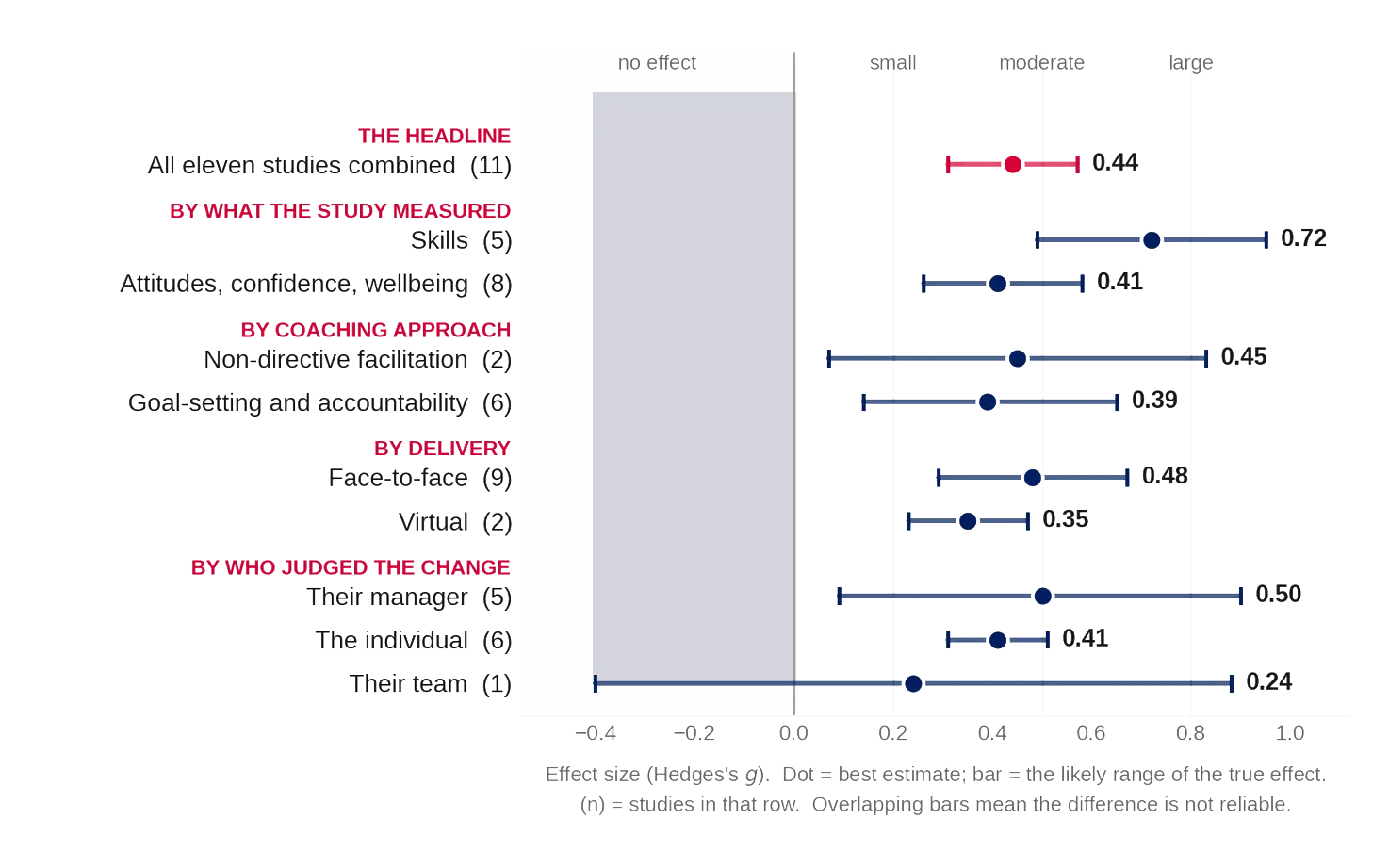
A 2023 meta-analysis in Frontiers in Psychology pooled eleven studies of workplace coaching and found a moderate, statistically robust positive effect (Cannon-Bowers et al., 2023). It is the third such review in a decade to reach that conclusion, following comparable analyses by Theeboom and colleagues in 2014 and Jones and colleagues in 2016. Whether coaching works is, for practical purposes, settled.
Every way you cut the data, it still works
Every way you cut the data, it still works
This is the most useful finding in the analysis, and the most widely ignored. The researchers tested the obvious candidates for “the right way to coach”: non-directive facilitation against goal-setting and accountability; face-to-face against virtual; skill outcomes against attitude and wellbeing outcomes; improvement judged by the manager against improvement claimed by the individual. Every comparison pointed the same way, and none of the differences between them was statistically reliable. The largest single estimate was for skill-based outcomes, such as those which follow a learning input designed to effectively give people new skills which are required immediately.
Be clear about what that does and does not mean. The current research does not favour one methodology over another. What it does tell you, unambiguously, is that all of these approaches work. So stop waiting for the methodology argument to be settled before you start. The returns come from undertaking any coaching at all, competently and consistently.
More is not automatically better
More is not automatically better
Across all three meta-analyses, neither the number of coaching sessions nor the total hours predicted the size of the result. What we infer from that is that volume is not a strategy. A few well-aimed conversations about one specific behaviour will do more than a long series of unfocused ones.
What kills coaching is usually not the coaching
What kills coaching is usually not the coaching
Rummler and Brache put it best back in 1990: “pit a good performer against a bad system and the system wins almost every time” (Rummler & Brache, 3rd edition, 2012). Recent UK workforce research bears them out. Across 5,000 workers, one in three said their organisation actively makes it harder, not easier, to do a good job – citing slow processes, unrealistic workloads, outdated systems and constant interruption in roughly equal measure (Ipsos Karian and Box, 2026). In those environments, motivation, pride and advocacy fall by between 37 and 54 percentage points. You cannot coach someone out of a broken system, and attempting it is how coaching acquires a reputation for being a waste of time. Hold those findings in mind. Everything that follows is an attempt to act on them.
Plan before you coach
Most coaching initiatives fail before the first conversation, because too little groundwork was done. A few organisations have a genuine coaching culture, where managers and their people both expect it to happen. Unresolved obstacles do not stay quiet: they harden into active opposition, and a project that begins mired in it rarely recovers.
Two questions are worth forcing at this stage. What are the three or four capabilities that genuinely differentiate performance in this business, given its strategy? And what in the working environment is currently stopping people from using the capability they already have? The second is the one organisations skip.

Get backing from the top
Senior support sets the expectation that coaching is a priority rather than an optional extra. Two words matter: visible and sustained.
Too many initiatives open with a blaze of publicity and senior enthusiasm that evaporates the moment attention moves elsewhere. Nothing gives coaching more impetus than senior managers who personally follow up on both its frequency and its impact. It is also worth agreeing in advance what sanction applies to a manager who simply doesn’t do it – an uncomfortable conversation to have at the outset, and a much more uncomfortable one to have later. Coaching slides down a priority list with remarkable ease, and regular senior attention is the most reliable brake on that slide.

Enable your coaches
Not every manager has the skills to coach, and some will not admit it. Fear of being exposed is one of the quieter engines of manager resistance. It also runs the other way, people resist being coached when the coaching they receive is unhelpful.
Two things are needed. Coaches need training in how to coach. They also need real credibility in the skill they are coaching, because few people take instruction seriously from someone they believe knows less than they do. If coaching matters, make the space and time for managers to make it happen.

The power of structured coaching
Learn to overcome the three biggest coaching barriers and explore how AI coaching tools can support coaching initiatives.

Coach the middle, not the tail
The instinct is to coach the poor performers, because they are the most visible problem. Resist it.
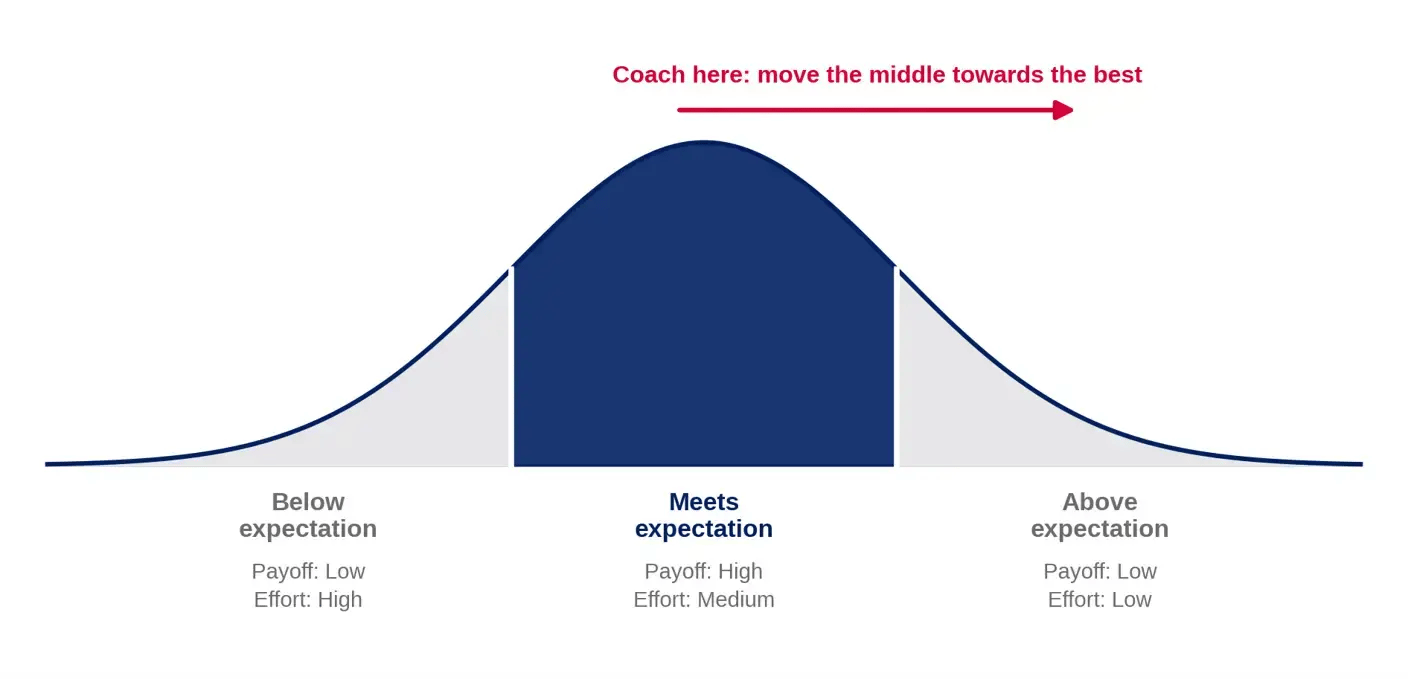
Performance in most populations follows a familiar curve: a small group well above expectation, a small group below, and the large majority in the middle. Working with the below-expectation group is hard and slow, and at best converts poor performers into average ones – a low payoff for high effort. Your best performers are the opposite trap: coaching them is easy and pleasant, but they are already delivering and there are very few of them, so the payoff is just as low.
The return is in the middle. Moving the large average group towards the standard set by your best people is where the arithmetic works: this group improves fastest for the effort invested, and there are far more of them. Shifting the bulk of a population from average to good transforms aggregate results in a way that rescuing the tail never will.
Match the style to the person
Coaches have to adapt. A new starter needs something very different from an experienced hand, and the most common coaching error after picking the wrong people is using the same style on everyone.
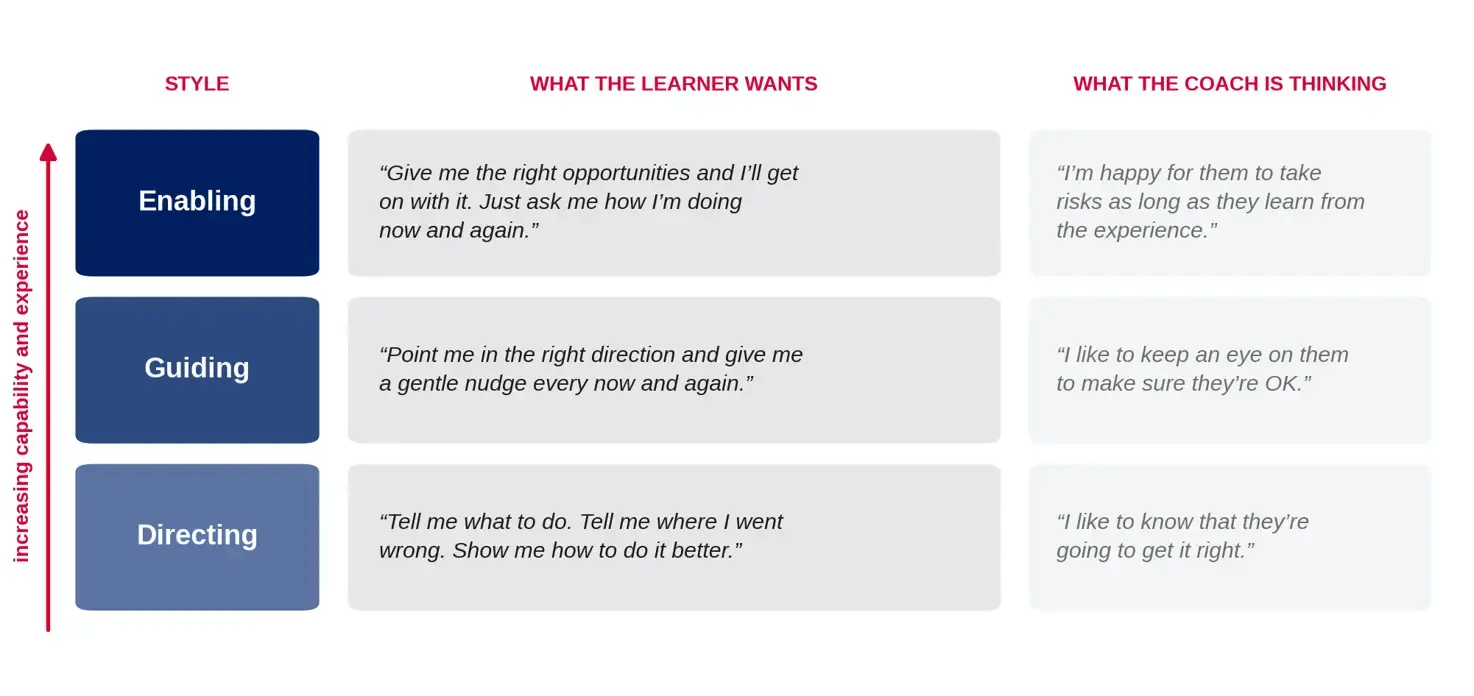
Three styles cover most situations, and what selects between them is how far along the person is. Directing suits someone who does not yet know what good looks like: tell them, show them, correct them. Guiding suits someone competent and still developing – a nudge and a regular check rather than instruction. Enabling suits someone who knows their job: give them the opportunity, support planned action then stay out of the way and ask how it went.
Note that the research gives you licence to be pragmatic here. Since no coaching school has been shown to outperform another in aggregate, the question is not which approach is theoretically correct, but which one will benefit the person in front of you. Getting that judgement wrong wastes effort at best, and damages confidence at worst.
Protect the rhythm
Weekly is ideal; fortnightly should be the floor. Not because volume buys results – the evidence is clear that on its own it doesn’t – but because rhythm is what turns coaching from an event into a habit, for both parties. A conversation that happens only when time allows is a conversation that stops happening.
How long to keep going depends on the individual, the number and complexity of the skills involved, and how often real opportunities to observe arise. Be realistic about capacity. Three or four people is a genuine coaching load for a working manager. Six-plus is a burden which leads to rushing, poor preparation and coaching quickly descends to the level of tick-box exercise.

Don’t start what you won’t finish
Experience and the available evidence point the same way: raising expectations and then abandoning coaching is worse than never starting.
It damages morale, and it damages the relationship between the person and their manager. There is also a real risk that performance falls, as someone applies half-learned skills without support, or reverts to previous practice. Coaching is an intervention, and interventions have side effects when they are done badly or stopped abruptly.
If you cannot sustain it, don’t announce it.

Work on a few things at a time
Trying to change several things at once rarely works. Pick one and stay with it until the change holds.
There is a mechanism behind this. Behaviour under pressure depends on having mental capacity available in the moment, and that capacity is easily exhausted by complexity and competing demands. Give someone six things to think about differently and they will revert to the habits they already have. Give them one, and they have a chance.
Choose the area with the largest return for the effort required, or the one that matters most to the business. Then be patient – some changes take time to embed, particularly complex ones. A single genuine improvement can move performance materially.